
However, in 2026, this approach is becoming increasingly risky.
With price volatility, supply constraints, and regulatory pressures, businesses are now re-evaluating whether spot buying is still viable — or if structured contract sourcing offers a better path forward.
Understanding Spot Buying
Spot buying refers to purchasing cocoa at current market prices for immediate or near-term delivery.
Advantages:
- Flexibility in purchasing
- Ability to take advantage of price drops
- No long-term commitment
Limitations:
- Exposure to price volatility
- Uncertainty in supply availability
- Limited control over quality consistency
In stable markets, spot buying can be effective. In volatile markets, it becomes unpredictable.
What Is Contract Sourcing?
Contract sourcing involves securing cocoa supply in advance through structured agreements.
These contracts define:
- Volume
- Quality specifications
- Delivery timelines
- Commercial terms
This approach is designed for buyers who require reliability and long-term planning.
Why Spot Buying Is Risky in 2026
Several market conditions have increased the risk of spot purchasing:
1. Price Volatility
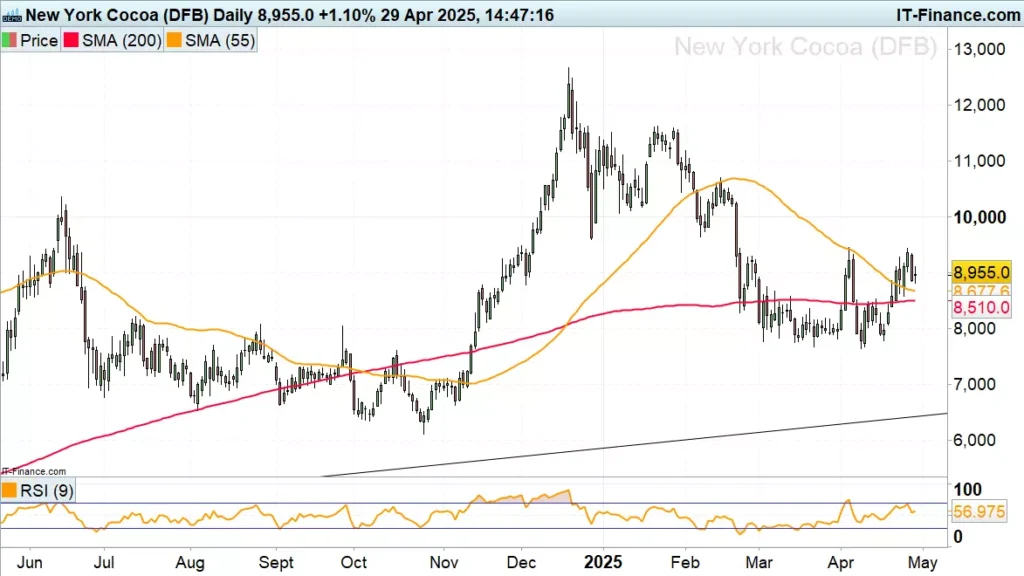
Cocoa prices have experienced sharp fluctuations. Buying at the wrong time can significantly increase costs.
2. Supply Constraints
Limited availability means spot markets may not always have sufficient volume.
3. Quality Variability
Spot purchases may involve mixed or inconsistent grades.
4. Competitive Pressure
High demand can lead to rapid price spikes and limited access.
The Strength of Contract Sourcing
Contract sourcing provides stability in uncertain conditions.
Key Benefits:
1. Price Predictability
Contracts reduce exposure to sudden market fluctuations.
2. Assured Supply
Volumes are secured in advance, reducing availability risk.
3. Defined Quality Standards
Specifications are agreed before shipment.
4. Better Planning
Supports production scheduling and inventory management.
Cost vs Control: The Trade-Off
Spot buying may sometimes offer lower prices — but at higher risk.
Contract sourcing may involve:
- Slightly higher initial pricing
- Less short-term flexibility
However, it provides:
- Greater control
- Lower operational risk
- More predictable outcomes
For many buyers, this trade-off is becoming worthwhile.
Hybrid Procurement Models
In 2026, many companies are adopting a hybrid approach:
- Core volume secured through contracts
- Additional volume sourced through spot markets
This balances:
- Stability
- Flexibility
- Cost optimization
Hybrid models are particularly effective in volatile markets.
The Role of Structured Fulfilment
Contract sourcing is most effective when supported by structured fulfilment systems.
This includes:
- Origin capacity validation
- Phased allocation planning
- Coordinated logistics
- Documentation alignment
Without these elements, contracts alone cannot guarantee successful execution.
Which Approach Is Right for You?
The choice depends on your operational needs:
Spot Buying May Suit:
- Small-scale buyers
- Flexible production models
- Short-term purchasing needs
Contract Sourcing Is Better For:
- Medium to large manufacturers
- Buyers with fixed production schedules
- Companies requiring consistent quality
The Market Is Changing
The cocoa market is becoming:
- More volatile
- More regulated
- More quality-driven
In this environment, procurement strategies must evolve.
Reactive purchasing is being replaced by planned sourcing.
Conclusion
In 2026, the question is no longer whether cocoa can be sourced — but how it should be sourced.
Spot buying offers flexibility but comes with significant risk.
Contract sourcing provides stability, predictability, and control.
For businesses seeking long-term reliability, structured procurement is becoming the smarter and more sustainable choice.